Biggest Lottery Jackpot?

Nobody has won the Powerball lottery in a while and the jackpot has now risen to $1.6 billion, the biggest jackpot in history. In 2013, I wrote about how to calculate whether the odds were in your favor to play the lottery. It almost never is, but because money from past weeks accumulates, it is possible at least. It is made especially challenging if you take into account the taxes you will pay on the winnings, which will be taxed at the maximum rate of 37% federal and 5.75% for Georgia state income tax. When I ran through the calculations last, I figured the Powerball jackpot break even jackpot would need to be $1.65 billion. That was then. The lottery really inflates the value of the jackpot by adding together all of the payments over 30 years. Using time value of money calculations, the “present value” is much less. And they skew it even further by using a graduated payment where you get paid more as time goes, putting more of your payments further into the future and making the present value even less. So for the last big jackpot in January 2016, the cash value of the jackpot was only 62% of the total jackpot. But tonight’s jackpot of $1.6 billion has a cash value of only $782 million or about 49% of the advertised jackpot. I don’t know when they went to the graduated payments, but a big difference this time around is that interest rates are higher. The lottery sets aside some amount of each ticket sale to fund the big prize. The money they collect plus whatever they got in past jackpots that went unwon is the cash value of the jackpot. Then they calculate a total jackpot by doing some time value of money calculations and figuring that money that sits in their savings account will earn a certain amount of interest until it needs to be paid to the winner. Just like a savings account with a higher interest rate will leave you with more money in the future, the higher interest rates means they can pay out a lot more in the future than they can now even if they start with the same amount of money. So tonight’s record-breaking jackpot of $1.6 billion beats out the January 2016 jackpot of $1.59 billion dollars, but back then the cash value of the jackpot was $983 million, way more than the $782 million at stake tonight.

When I run through my calculations to determine a break even jackpot, I always use the cash value, so that I can compare today’s $2 ticket price to today’s cash prize. Back in 2016, the break even advertised jackpot was just over $1.6 billion. But with higher interest rates and the graduated payout scheme, the break even jackpot today is a staggering $2.2 billion, even though the odds of winning have not changed. So I am sitting this one out.


Donor Advised Fund

I have been thinking about how to write my will and handle my estate. Once the estate pays off all of its bills, a lot of the remaining money will go to different charities I have supported over the years. However some of the money is in my deferred compensation account and another chunk is in an IRA that was converted from my old 401k account. I never paid any income taxes on the contributions to those two accounts and the idea is that when I need the money and withdraw it, I will pay taxes on it as ordinary income (including the gains). If I die, whoever gets the remaining money would be able to keep the money in the account for a little while maybe, but eventually would have to withdraw it and pay income taxes on it. My regular investments and my Roth IRA do not work this way. No taxes would be due and the cost basis of the investments is adjusted to whatever the value would be on the day I died. So investment assets can be inherited without any taxes being due, but not 401k’s and conventional IRA’s.
Continue reading “Donor Advised Fund”

Raising the Flag

On the morning of September 14, 1814, after a day and night of constant shelling by the British at Fort McHenry, the American defenders raised the biggest flag they had over the fort to show the British and the people of Baltimore that they still controlled the fort. Unable to take the fort, the British withdrew. Upon seeing the flag in position that morning, Francis Scott Key started a poem that would become the lyrics to the national anthem of the United States. One day and 208 years later, I visited. It just so happened I got there right at 10 AM, which is when they raise the flag and I got to help out the guy, Roy, who usually does this. Even though there were no British around and we used a much smaller flag, it was still pretty cool. The good thing is we had zero casualties.

We started with the folded up flag, which I got to hold all by myself, and then I unfolded it while Roy held the other end.


Continue reading “Raising the Flag”

I Bond Interest

I bought an I Series savings bond last year and then another one this year. Since they are indexed to inflation, they have been earning a lot, though ultimately you gain nothing in purchasing power. The rules for I bonds can be pretty complex, like anything involving the federal government. The bonds earn interest every month, but it seemed very odd that both of my bonds, bought 3 months apart and earning different interest rates, were worth exactly the same amount of $10,236.00 (both purchased originally for $10,000). One part of it is that the amount the US Treasury tells you is the value does not reflect the last 3 months of interest since you forfeit 3 months of interest if you redeem the bonds before 5 years (and you can’t redeem them at all the first year, so I guess they are worth nothing right now). I also thought it was odd that the bond value each month has always been to a whole dollar amount, though since my principle was a very round number of $10,000, maybe that isn’t entirely unlikely. However today I found out more about how they calculate the actual monthly interest and decided to make a spreadsheet to try to keep up with it instead of just checking in with US Treasury. I like that it is all based on rules and ultimately I was able to replicate Treasury’s numbers. It helps that I found a wiki page at Bogleheads that explained it, but I still had to do the calculations myself before I could really see what was happening. The really weird part of it is that Treasury calculates interest on any size bond as if it is a bunch of individual $25 bonds. Then they round off the interest earned on the $25 bond to the nearest penny. So if you were to earn 1.73% interest on $10,000 you might expect to end up with $10,173. But because a $25 bond would be worth $25.43, you earn as much as 400 $25 bonds, or 400 * $25.43 = $10,172. It’s only $1, but if you are trying to verify the numbers it might throw you. Since I have 400 $25 bonds and the interest on those $25 bonds is rounded to the penny, the value of my bonds will not only always be to the nearest dollar, but the nearest $4 since 400 * $0.01 = $4.00. Also, while the bonds earn interest every month, the interest is compounded every six months. So they calculate the interest on the original amount for 5 months before adjusting the principle on the sixth month (which is also when the interest rate changes). That is a little tricky too.

The other part is how to take out the most recent 3 months of interest. I was trying to think of a formula that would do it, but would be smart enough to be able to accommodate when the interest rate changes during that 3 months. But since I was calculating the value for every month anyway, it was easy to just say that today’s reduced value is the same as the full value from 3 months ago. Really easy. Once I did all of that I was able to regenerate the numbers, but a lot depends on the roundoff of the $25 bond.

The interest rate itself is always rounded to 2 decimal places and is based on the CPI-U numbers published by the Bureau of Labor Statistics. Since BLS publishes the inflation rate monthly and the last one before the bond rates change comes a couple of weeks before you can actually predict the rate that Treasury will use. The unknown part of Treasury’s rate announcement is the fixed rate that Treasury gives, but for years they have made that really easy by having a fixed rate of 0%. With interest rates still pretty low right now, but inflation very high, I thought Treasury might make the fixed rate negative, but they haven’t done that. Even during deflation when inflation is negative, the savings bonds never lose value and the earnings rate doesn’t drop below 0%.

There are other bonds that Treasury sells on the market called TIPS which are inflation adjusted, but because inflation is so high the yield determined at auction has been negative lately so that the true yield ends up below the inflation rate. TIPS are weird too because they only pay a dividend of the auction rate while the principle value of the bond varies with inflation, so the dividend you receive would be at least 1/8% (not negative since then you would have to send them money) and they apply the negative portion by reducing the principle. So you don’t get barely any dividend and the principle ends up not keeping up with inflation. The downside of the I bonds is you can only buy $10,000 in a calendar year.

Tire Repair Kit

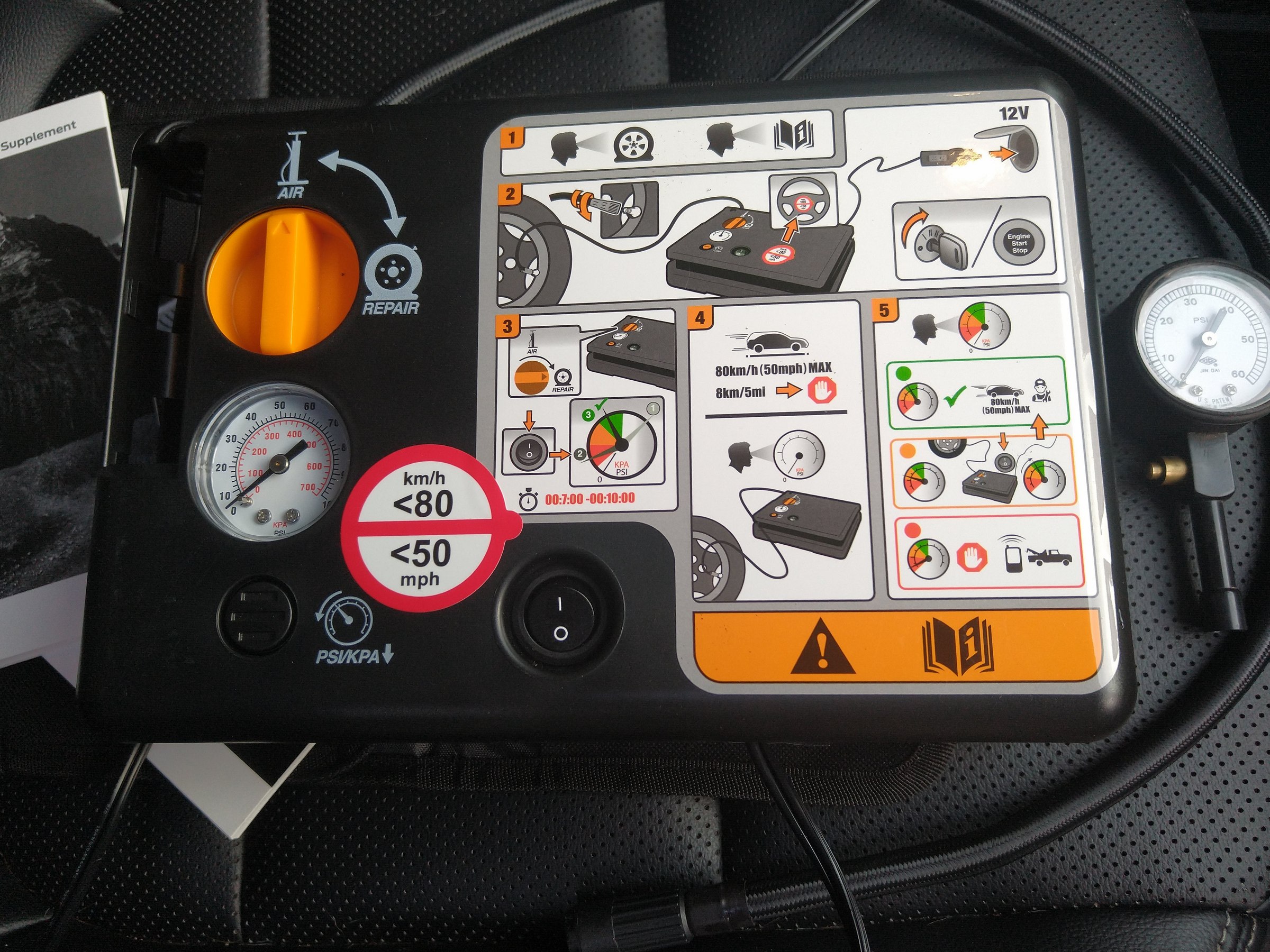
When I bought my Ford Escape in August 2020, it did not include a spare tire, not even one of the miniature tires. Instead it included an electric air pump that you plug into the lighter socket, called the “Tire Sealant and Inflator Kit” or “temporary mobility kit”. It includes a switch that can activate a canister of latex to repair a tire if it had a leak, but this would be ineffective if the hole was too large or if you had a blowout. The latex fix was temporary and ideally would get you someplace that could do a better fix. It seems like I read somewhere that once you used the latex, the tire would never be good again and would have to be replaced, but the owner’s manual doesn’t say that, just that you have to replace the valve stem and tire pressure monitor for that tire. The advantage of this system is it is lightweight, compact, and cheap, reducing weight of the vehicle, increasing mileage, and increasing space in the car. For the hybrid the tire well is also where they decided to put the 12V car battery, so no way to just get a tire. It is also easier to operate than using a jack, removing lug nuts, and replacing a tire. However, the latex canister expires in 4 years and has to be replaced. The disadvantage of this system is you can’t go that far or fast once you do the repair (like with the mini tires) and doesn’t work if damage is severe. The mini tire was a compromise compared to having a full size tire, and this inflator is a further compromise.

In the previous couple of weeks I had driven the car to Washington, DC without any incident, but I was driving a few miles to Jeb’s house when the car alerted me about low tire pressure in my right front tire. The car has a display for pressure in the tires and the other tires were all okay, so this wasn’t just a seasonal thing. The pressure was 25 psi and the other tires were around 30-32 psi. Very quickly as I continued to drive it dropped to 21 psi and I thought I might not make it to Jeb’s. As I found a place to pull over it was down to 18. As I parked it was 16 psi. I got out and could hear air escaping the tire and could even feel the air coming out of the tread. Time to try out the kit!

Tire Sealant and Inflator Kit
Continue reading “Tire Repair Kit”