
I am now in my tenth year on Georgia Power’s Simple Solar plan which charges me about 10% more than regular customers and all of my electricity is solar. Sort of. Really I am buying Renewable Energy Credits (RECs), which are an accounting gimmick so that you can buy and sell solar energy credits. The RECs are purchased from someone producing solar energy and then they use or sell the electricity back to the grid. It is like buying a carbon offset. But if a big company wants to run its factory on solar and builds a 1 megawatt solar plant to run it, it would probably say it is running the factory on solar, but I bet it would still sell the RECs. So it is kind of second hand solar. RECs are fairly cheap to buy which is why I am not paying that much. Still maybe it means something. Georgia Power’s mix of electricity sources is now up to 7% solar, which is better than in the past, but not great.
Georgia Power also has a program called Community Solar where you pay $24 per month to buy the output of a 1000 watt block of actual solar cells that Georgia Power operates somewhere in Georgia. Georgia Power then lets you reduce your power bill by the actual number of kilowatt-hours those cells produce, which they say on average is 165 kWh per month, but can vary from 115 to 215 kWh. At first glance it looks like this would generally save me money, but it isn’t easy calculating the costs.
My average monthly consumption is 300 kwh. I want to see how much taking off the average Community Solar power production of 165 kwh will affect my bill and whether that is more or less than the $24 that the program costs. Using the end price I calculated that I pay per kwh from Georgia Power, I would pay $26.61 in Winter for 165 kWh and in Summer I would pay 27.70 using the rates that went into effect on June 1, 2026. So I could come out a little ahead unless they charge sales tax on the $24 fee which would be another $1.92 and wipe out almost all of the savings, though I still might come out ahead by less than a dollar per month on average. Because they charge sales tax on everything else on my bill, I feel like they almost certainly will charge sales tax on the Community Solar fee. However I called them and they said they don’t charge sales tax on that fee (edit: they were lying). I also question whether they carry the reduced consumption through all of the calculations (edit: they do) or if they just discount it in Tier 1 and not anywhere else. I signed up, so we will see what happens.
I couldn’t find anyone who has posted the amounts of their Community Solar production, so it will be interesting to see how those numbers vary. Generally, longer days would mean more production in the summer, but I have read that solar hardware is more efficient at cooler temperatures. Also for a rooftop installation, the fixed angle of the solar panels gives differing output throughout the year, providing less when the sun is directly overhead than when the sun is a little lower and matches the slope of the roof a little better. One would think a utility size installation would track the sun’s angle. However, I feel pretty sure that there will be more production in Summer, meaning they will take more kWh off of my bill in Summer when rates are a little higher. Though I rarely get into the more expensive Tier 2 rates in the Summer, households that use more electricity might be able to reduce Tier 2 consumption, saving additional money. I save very slightly more money because Simple Solar is an extra fee based solely on energy consumption, but Simple Solar isn’t much in the first place.
I don’t know that doing this means that Georgia Power is really building any more solar panels than they would have otherwise, though they did build (or their partners built) two solar farms in South Georgia for this program a few years ago. They were probably building some number anyway because they have to or got some kind of tax credit, and they are just letting me pay for something they were going to pay for anyway. It also seems suspicious that the fee for the program almost exactly matches what they would charge for the power it produces. I doubt most people know about these two easy solar programs and even fewer people have probably signed up. It would be a nice problem to have if the majority of their customers signed up for these.
They used to have a program where if you installed solar panels on your house and still wanted Georgia Power service that you had to sell all of your solar power to them (and the RECs) at some rate and then they would sell you power at the regular rate. That always seemed like a twisted way to run a program, but maybe it had something to do with how they meter consumption. I don’t know how it works now, but they do have a net metering program where you can sell excess power back to them at about half the price they charge you (they only want to give you what it would cost them to make power, so they give you their production cost, but charge you a retail cost when selling to you) and I think you also have to pay a monthly fee.
Community Solar Production by Month
Georgia Power says expect to see between 115 and 215 kWh per month from a 1000 Watt block with an average of 165 kWh.
- Jun 2026: 156 kWh
- Jul 2026: 154
- Aug 2026: 148
- Sep 2026: 139
It has been a week since I signed up for this and I still haven’t heard anything back. I even signed up again, thinking maybe I didn’t finish the sign up process the first time. I hope I don’t end up signing up for two blocks since that would be more than I usually use. Looking at some of the small print for the program they say it is first come, first serve, and signing up does not mean I will be enrolled and that I could just be added to a waiting list.
I wrote to Georgia Power yesterday asking about my status and I got a response today saying I am in the program. I suspect that is why I got a bill for a partial month this morning.
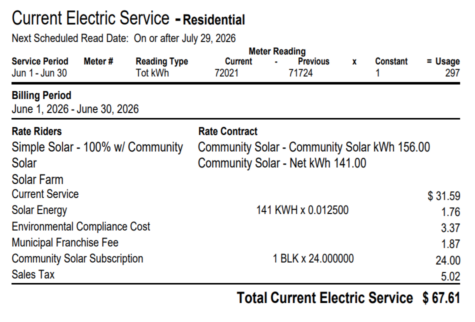
I got my first bill while on Community Solar. They adjusted my billing period so that it ran from June 1 to June 30, which they say is 29 days. My consumption was 297 kWh, but Community Solar produced 156 kWh (seems like the June harvest should be above the average of 165 kWh that Georgia Power claims) for a net usage of 141 kWh. Then they included a $24 charge for Community Solar and the total bill came out to $67.61. If I calculate a bill for 141 kWh in my spreadsheet, I get $40.65, plus $24 would be $64.65. So they are definitely charging sales tax on Community Solar’s $24 fee, even though the rep said they did not, and it is also included in the calculation for Municipal Franchise Fee which is a 3% fee. But for some reason Current Service on my bill ran 19 cents higher than my calculations, which then affects Environmental Compliance by 2 cents. The Public Service Commission has updated their worksheet for the new June 1 rates, but their worksheet does not let you input the solar programs that I am in. If I zero those two out in my spreadsheet, I get exactly what the PSC worksheet comes up with. The good thing is that none of the fees seemed to be using my total consumption of 297 kWh.