
Fan Lights Now CF

Almost all of the light bulbs in my house have been converted over to compact fluorescent bulbs using 75% less energy, but I was never able to replace the little lights in the ceiling fan of my bedroom until today. Today at Home Depot I saw that they had compact fluorescent fan lights. cfbulb.jpg The fan has candelabra bulbs in it that burn out all the time, so it would be nice if I could find something that wouldn’t burn out and would be more energy efficient. These have a kind of chubby shape to them and you can see a skinny helix inside the bulb despite the frosted glass that covers it. They’re certainly not as attractive. But they were also only $1 each. So I bought three of them. They are made with the narrow base that my light fixture uses, but they come with adapters so they can be screwed into a regular base. One of them has some flicker to it, so I will take that one back.
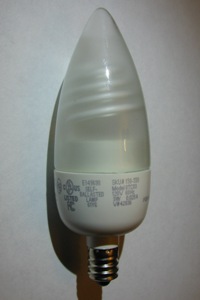
They seem to take a little while to get to full brightness. It isn’t just a few seconds, but maybe 30 seconds or more. The tint of the light is decent, but they aren’t quite as bright as the old bulbs I had in there, which are labeled as 25 watt while these CF bulbs are labeled 15 watt (and actually use 3 watts). Here is a mix of the bulbs installed for comparison with the incandescent bulb on the left and the CF bulbs in the middle and on the right:
Continue reading “Fan Lights Now CF”

Flashlight Suspension

I have been learning a lot about flashlights for the last year and most of it has come from reading the discussion forums at Candlepower Forums. I’ve learned enough that I have written a couple of reviews of lights and I answer questions from newbies every now and then (I’ve also done a lot of editing of their Wiki, which was terrible). By and large the people are very helpful and incredibly knowledgeable. There is just a lot to know. And there are thousands of threads for a newbie to search through, even using Google search. It helps that the forums are strictly moderated, so flaming, bad language, etc. are simply not to be found. They have a lot of rules and zero tolerance of people who break them.

Long story short, I got suspended from the flashlight discussion board. Not long, just for a day. Here’s how it happened.

Continue reading “Flashlight Suspension”

Deferred Compensation

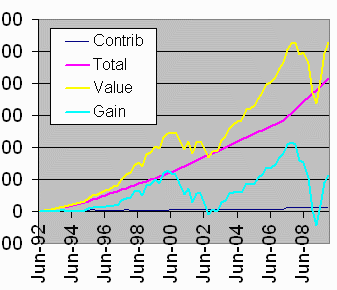
A few years ago, I wrote about my Deferred Compensation Plan at work and said that at the time, I was averaging a 7% return over the previous 13 years. Since Jeb posted his Green in Wintertime post, I thought I would post this graph which comes from a spreadsheet I use to keep up with how much I have contributed, how much my account is worth and the difference between the two which is the gain or loss.

defcomp2.gif

You always want the yellow line (the current value) to be above the pink line (total of my contributions). If the yellow dips below the pink, I am losing money. It has happened twice, but is not happening right now. The neat thing that happened in June 2000 was the blue line (gain or loss) crossed the pink line. That meant that my gains exceeded my contributions, or, in other words, I had doubled my money! At the time I had an average annual return of 33%, which was clearly unsustainable. About two years later, I had lost every penny of my gains and was showing an average annual loss of 1.18%. Five years later, I was showing a lifetime average gain of 11.3% but nowhere close to doubling my money yet. 18 months later, I had lost all my gains again and had an average loss of 0.31% per year over the previous 16 years. Now I’m showing a gain again of 4%, which is pretty lousy, but I’ll take it. Though the account value is back to where it was before the 2008 crash, you can see that today’s gains are about half of what they were then.

The Old P60 Drop-In

More research on flashlights, so you can skip this . . .

The main high-end US flashlight company, Surefire, sells innards of a flashlight called a P60. It consists of three parts: a reflector, a bulb, and the electronics that drive it. Surefire uses this assembly in several different models of flashlights. It has become a standard part and now many off-brands offer P60 drop-ins that can be used in Surefire lights. And because there are so many P60 drop-ins and Surefires are so expensive, now people make P60-compatible bodies that will accept the drop-ins. So instead of spending $150 on Surefire’s system, you can spend $18 for a generic.

Continue reading “The Old P60 Drop-In”

Green Weather Network

In 2006 Target had a sale on Oregon Scientific indoor/outdoor thermometers and I found out that they supported up to three different wireless temperature probes although they only came with one each. So I solved that by buying three thermometers and sharing the gauges. Two of the gauges read all three probes, while a third is only designed to read one probe, so I made sure that probe is the one outside (the other two are in my crawlspace and attic). Then in 2007 I got a wireless rainfall gauge which reads a tipping bucket gauge that is on my roof. It also came with a fourth temperature probe which runs at the same frequency as one of the other probes, but will be ignored by the other gauges as long as it is on a staggered 43-second reporting cycle. So I have the fourth probe in one of my closed off bedrooms to see how cold they get. Only the rainfall gauge reports that temperature.

Continue reading “Green Weather Network”