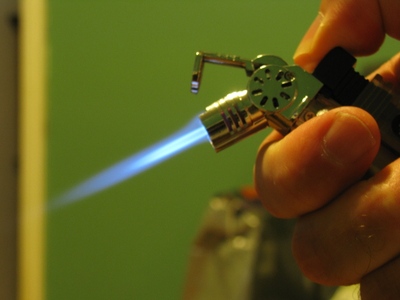
Heat Pipe

Heat pipes are one of those weird things that you don’t realize are all around you until you start looking. It is a copper tube with a near vacuum in it. It also has some liquid in it (usually water or ammonia). The idea is that if the bottom part of the pipe gets hot, the liquid evaporates and the gas rises to the top of the pipe. Then you cool off the top of the pipe and the liquid inside condenses on the inside of the tube and runs down the side of the tube all over. It is like a refrigerator but without any moving parts.

Heat pipes are used in heat sinks that cool off computer processors. They are also surrounded by fins and a fan that help cool the top part, so even if you open up your computer you may not see them. I learned about these this weekend helping friends out with their computer which was overheating. I am still not exactly sure what was going wrong, whether the liquid had escaped the tube or the tube had somehow deformed and was no long making contact with the slab of copper that goes on top of the processor (or if something software-related was making the processor work too hard). I put in some small metallic disks (dimes) to shim the tubes down into making contact with the copper slab and got some thermal compound to put around them as well and hope that will work. But if the liquid has escaped then it will never work. You could also buy a new CPU cooler but this particular computer is very compact and it is hard to find coolers this small. It only has two L-shaped heat pipes in the heat sink. I looked inside my Dell and it has 3 U-shaped heat pipes with a bigger fan. Wikipedia says a heat pipe is more efficient at moving heat than a solid piece of copper.

Diverging Diamond

I read a neat article recently at work about a graduate student who came up with a new way of laying out a highway interchange. The problem with interchanges is the traffic that has to turn left to get onto ramps or the crossroad. Left turns make for conflict points for possible accidents and make traffic signals less efficient because only 1/4 of the traffic gets to move at one time. Also, since left-turning traffic backs up into traffic going straight, you put them in dedicated storage lanes. So a 4-lane road might have 4 through lanes and 2 left-turn lanes on the bridge adding expensive bridge square footage (about $100 per square foot). So what this guy did was said why not put an intersection at each end of the cross-road that shifts traffic to opposite sides of the road so that people actually drive on the wrong side of the road over the bridge? If you are on the left side of the road already, it is easy to turn left onto the ramp. And people coming off of the ramp who would be making a left could also make an easy left (if they are turning right they merge in on the other side of the intersection so it still works like an easy right). Anyway, this is called “diverging diamond” interchange as opposed to a regular old diamond interchange. The nice thing about it is that existing interchanges can be retrofitted to a diverging diamond. Another advantage is that by eliminating the need for left turn lanes, the bridge only has to carry two-way traffic, so it saves on the width of the bridge or lets you increase capacity of the interchange without widening the bridge and buying up the gas stations and restaurants that always show up on the corners.

After touting the interchange for several years with research spent on analyzing the design through traffic simulations, they found out that France already had a couple of these. But the first one in the US was just opened last year in Missouri and Georgia plans on doing several as well. You can click on the picture below for a bigger version. Notice from the crosswalks that pedestrians walk down the middle of the bridge.

divdiamond.jpg

Another similar concept, only without driving on the wrong side of the road, is a tear drop interchange where you put traffic circles (they are actually squished into tear drop shapes) on each end of the interchange. Here is an aerial view of one in Colorado. With traffic circles there are no left turns, everyone makes right turns. Another approach is to make the whole interchange a giant traffic circle: at the north end of the circle a bridge carries westbound traffic and the bridge on the south end carries eastbound traffic. You would need two (narrower) bridges this way but still avoid building left-turn lanes. Here is an aerial view of one in New York.

Praise You (Like I Should)

I remember watching some kind of MTV or VH1 compendium of best videos and seeing one I really liked for Fat Boy Slim’s song “Praise You”. It’s a pretty famous video, but probably a lot of people still have never seen it or even heard of Fat Boy Slim, who was in the 80’s British band The Housemartins under his real name, before mixing electronic music as a DJ calling himself Fat Boy Slim (and using an Amiga computer, no less, at least up through doing the music for the movie Moulin Rouge in 2001). I put the song on Grant’s MP3 player and he says it is one of his favorites.

Anyway, I was writing a review of the movie Where the Wild Things Are which I had very high hopes for since I always thought it was a cool children’s book and it has Spike Jonze directing. He also directed one of my favorite movies, Being John Malkovich and starred in a lesser favorite, Three Kings. Well, Wild Things didn’t turn out that great, but I looked up the movie on Wikipedia and wound up reading more about Spike Jonze. He got his start making commercials and music videos, which I knew. One of the videos he made, well into his career (after a number of videos and around the time of Malkovich), was for Praise You. And what I did not realize was that the main guy in Praise You is Spike Jonze himself as a nerdy community-oriented B Boy dancer. The video itself looks like something someone would shoot and put on YouTube, but at the time there wasn’t quite so much material out there like this. But it was certainly shot the same way, and when the manager of the theater comes out to turn their boom box off, that is real, since they didn’t get permission beforehand.

You can watch the video on YouTube and read more about the song on Wikipedia

Many Mini Daffodils

I planted a bag of mixed daffodils several years ago in the little plot in front of my house. It gets a lot of sun and the daffodils come back every year. The regular ones come up first and are followed a week or two later by these little multi-daffodils where several smaller flowers are on a single stalk. So all of the regular flowers have died back and all of these little ones have just bloomed. Time for the macro lens.

manymini.jpg

Fresh Ground Coffee

I’ve been using my Aeropress coffee maker for a couple of months now, making coffee a few times per week. After researching how to make a good cup of coffee I was looking forward to getting some fresh ground coffee once I worked through my brick of Publix decaf. At some point the Sunday paper came with a coupon for a free bag of Millstone coffee and even included the bag that you would take to the store. I scoped my Publix but all they had was pre-ground Millstone. Kroger had whole beans and a grinder, but the only type of decaf I saw was for Hazelnut flavor. With less than a scoop of the Publix brick left, I went to Kroger at Toco Hills today hoping they would have straight decaf. It turns out they did have it!

I have never ground coffee before. I remember Mom doing it when we were kids and would go to the grocery store with her, but not much more. I had looked at the machine earlier and noticed that you could vary the coarseness of the grind from French Press (big chunks) to Espresso (fine powder). In between that is Automatic Drip Coffee. The Aeropress says something finer than ADC is needed, but reviewers said an Espresso grind is harder to press the water through the filter.

Continue reading “Fresh Ground Coffee”