Trench 94

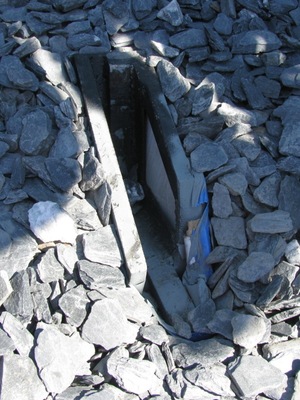
A lot of people (at least in the south) know that uranium fuel was produced in Oak Ridge, Tennessee during World War 2. However, plutonium was also used in the bombs and this was all produced at the Hanford Site in Washington state. Hanford is now the most contaminated nuclear site in the US and the site of the biggest environmental cleanup. It is also the home of Trench 94, which can be seen in satellite pictures available on Google Earth.

trench94.jpg

The United States launched its first nuclear powered submarine, the Nautilus, in 1954. And it has built hundreds more since then. Many of them served out their lives and were decommissioned. The problem then was what to do with the old nuclear reactors they carried. The old fuel was removed for processing or storage, but this still left a big piece of radioactive metal. So what they do is put the submarine in dry dock, cut everything in front of the reactor off, then everything behind the reactor off, This leaves them with a big steel cylinder. They then attach a plate to the front and back, barge it up the Columbia River to the Hanford Site, and put it in Trench 94. So each of the barrels in Trench 94 is actually a piece of submarine. You can see the process on this web page. One guy has put together page about that numbers all the reactors and tells which submarine they came from (that picture is at the bottom of this page.

Most of the reactors have been there for a while, but supposedly the trench has been left open so that Russia can verify the submarines are scrapped. Plus they probably keep having to put more reactors there. These containers are supposed to last for 600 years.

Fire

I saw an article about fires in southern Georgia recently. One of the fires has burned a huge area of more than 200,000 acres. The fire even has a name, the Honey Prairie Fire. You know it’s a really big fire if it even has a name. Not only does it have a name, it has a Wikipedia entry. 200,000 acres is a huge area: 400 square miles. Today I found out that almost the entire area is in the Okefenokee Swamp and particularly the national wildlife refuge. According to this page it looks like about two-thirds of the wildlife refuge has burned. Here’s a map showing the extent of the fire, but keep in mind that even the green part has also burned, it just burned back in May when the fire was first started by lightning. Maybe not so surprising, the Okefenokee Swamp is closed right now.

I don’t know how worrisome any of this is. The swamp is supposed to catch fire every now and then and clear out underbrush. However there has been a really bad prolonged drought in the swamp, so bad that some of the places where they take canoe trips are just dry ground now.

Glider Snatch

I was watching last night’s Daily Show today and the guest, Mitchell Zuckoff, was promoting his book, Lost in Shangri-La, about the rescue of some plane crash survivors in New Guinea during World War II. Some airborne soldiers parachuted in first and cleared off a patch so some gliders could land. Eventually they flew everyone out on gliders, which Zuckoff said was done with rubber bands, so I envisioned them building a giant slingshot and shooting the gliders into the air. I knew gliders were used on D Day, towed behind airplanes from England, but it was a one-way mission to land troops and equipment together in fields rather than spread out like paratroops would be. I didn’t think they could take off again especially since there was no runway, just a clearing. I found an interview with the commander of the rescue mission where he said they snatched the gliders up and everyone got out okay. Then I had to look up exactly how you snatch a glider up. It turns out they would tie an elastic tow rope up on some poles and a plane would fly in very, very low with a hook lowered that would catch the tow line and yank the glider up into the air. There’s even a YouTube video:

CHDK

Today on one of the flashlight discussion areas, a guy had taken some macro photos of a flashlight he had taken apart. Someone said that if he used a Canon camera, he should use CHDK, which allows you to create RAW images and add a lot of features to your camera. Well, I have a Canon camera. And one of the things I would really like for it to do when I’m taking pictures of flashlight beams (shining them on a wall to see what tint, brightness, and beam pattern you get) is to turn off the automatic white balancing that the camera does. If I have a flashlight with a cool white, bluish beam, the camera will reduce the blue color and make it look more white. If the flashlight has a warmer, more orange, tint, the camera changes it to make it more white. So I end up with two pictures that look the same even though the tints are very different. I can shine both lights at the wall, which helps some, but often the camera will exaggerate the differences, especially if the tints are fairly close. So I’d like to be able to turn that off, but the only way I can figure to do that is some process where you take a picture of something that is totally white in order to set your own white balance. And I don’t know if that is stored or if you have to do that every time you want to take a picture.

Continue reading “CHDK”

Battlestar Galactica

For the last couple of years, I have been watching episodes of Battlestar Galactica on my Palm and then iPod. This isn’t the series from the 70’s with Lorne Greene, but the newer version that started in 2004 on the SciFi channel (now just SyFy). But the basic plot was the same in that robot Cyclons wipe out the human race except for a few spaceships full of people, led by a military spaceship called, the Battlestar Galactica, who all go searching for Earth which many think might just be a myth. I finally finished it up this week (I won’t tell you how it ends).

The series is a lot darker than the original. And they did make some significant changes, like some of the hotshot fighter pilots are now women and in addition to classic robotic cylons, there are humanoid versions that look like regular people (except better looking generally). The humans dismissively call the Cylons “toasters” or “skinjobs.” One of the hooks is that even though the Cylons have this great technology to make robots that look exactly like people, they only have a limited number of molds, so a lot of the Cylons look just alike. This is good for the actors because they can get killed and one of their copies can still show up in the show. Speaking of copies, one of the actors from the original series (Richard Hatch, who played Lorne Greene’s son, Apollo) got a minor, but recurring role in the new series.

Anyway, the original series only lasted one season, but the new one got a lot of acclaim for an original cable series and lasted four seasons. It is produced by a guy who worked on several of the Star Trek TV series sequels that started in the 90’s. There are a lot of neat sci-fi twists and even religious storylines (the humans believe in multiple gods, and it turns out the Cyclons believe there is only one God).

Honestly, the series wasn’t always that great. I thought they made some of the characters do kind of stupid things in order to make certain plotlines work. It was still worth watching though, all the way to the end when either the humans are wiped out by the Cylons, find Earth, or none of the above. But it certainly had a lot of neat ideas and concepts in it. And the cast was large enough, not even counting the duplicates, that there was always a lot going on. And the nice thing is it didn’t overstay its welcome like some shows (Lost).