Swings and Roundabouts

This weekend I got an e-mail from a guy in Scotland concerning battery packs. He said he was looking for one for an Archos video player. I said the Archos looked interesting and asked how he liked it. He said it had some advantages over the 5G iPod (larger screen) and disadvantages (it’s bulkier). He wrote “it’s swings and roundabouts.”

I knew what he was saying but looked up that unusual phrase anyway. It’s a British idiom that means there are tradeoffs and is short for “What you lose on the swings, you gain on the roundabouts,” which doesn’t make it any clearer.

Telstar Ranger

Tonight I was reading up on video games on Wikipedia and wound up reading about the Atari Computer that we used to have (the Atari 400) and before too long I found the Coleco Telstar Ranger. This was the first video game system we ever had. It was a little more advanced than PONG, including six games, including a pretty cool old West “gun” that you could use to shoot targets on the TV screen.
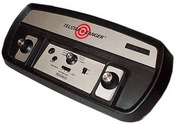
Just seeing a picture of the console brought back memories. The controllers were just dials that you could rotate to make something go left and right or up and down. There wasn’t even a button. They either sat in the console or you could connect a wire to them (which was a neat concept; early Coleco models didn’t have a detachable controller). I have no idea how the gun worked, but it was pretty neat technology, even if it didn’t make for a great game.

They had “tennis” where you would bounce a ball back and forth with the other player and try to get it past them.

With “hockey” you tried to get it past the person and into a goal. You had a goalie and a forward that moved in unison. I remember that being a pretty good game. When you changed levels your player would get smaller and the ball would move faster. At the highest speed it was pretty much impossible.

They had “handball” where both players were at one end of the screen and bounced the ball off the other end, taking turns for responsibility of keeping the ball from going past.

I think “Jai Alai” was just handball with two people on your team. That was the first I had ever heard of jai alai.

“Skeet” sent a ball across the screen from left to right that you had to shoot.

“Target” allowed the ball to bounce off the edges until you hit it.

That same year, 1977, Atari released the 2600 which had much better games that were in color. Wikipedia says that the 2600 was an early 2nd generation home video game, whereas the Coleco was 1st generation (today’s Xbox 360, Playstation 3, and Nintendo Wii are 7th generation). I remember Jeb and I (and Grant sometimes) going up to the Northlake Sears to play Combat. Eventually, after the 2600 was obsolete, Grant bought one from one of his friends and we played that for a while.


Project Management

Several years ago I watched a series of PBS specials about the development of the Boeing 777 airliner. Some searches on the internet found the title to be 21st Century Jet: The Building of the 777. It isn’t available on Amazon, but can apparently still be purchased from the Boeing Store. The film makers had an amazing amount of access as they filmed meetings, talked to engineers, suppliers, etc. It was a perfect case study in project management.

Boeing’s goal was to develop a long-range plane to fill a niche just below the capacity of a 747. With a 5-hour series the documentary was able to go into detail about certain issues (for instance the difficulty in getting a 2-engine aircraft certified for trans-ocean flights or how they test turbine blades). It was fascinating to watch the pieces come together. One way to save money was to do virtual testing of the engine instead of using a flying test platform. The engineers thought they wouldn’t even need to do the real-life tests because their models were so good. But the decision was made to do the test on a full-scale prototype anyway and on the first flight the engine flamed out (they used a 747 so they still had 3 other engines). The engineers went back and found a flaw in their computer model.

Continue reading “Project Management”

DVD Kiosk

About a month ago I noticed a DVD rental kiosk at Kroger promising $1 per day rentals. I kept meaning to look at it more closely, but someone was either already at it, it was offline, or I was in a hurry to get out of the store. Yesterday I finally stopped by and rented a movie that I had kind of wanted to see but knew Susan would never want to watch (Talladega Nights: The Story of Ricky Bobby, C+, probably worth a dollar).

I guess the machine (about the size of a large coke machine) is filled with disks. They seem to have almost all of the releases from the last year, probably over a hundred movies, and with multiple copies there are probably 500 disks inside. There is a computer on the front with a touchscreen that lets you browse movies by genre and they seem fairly current with new releases. They take only credit cards and give you until midnight the next day before you are charged another dollar. After 14 days they charge you $35 plus tax to keep the movie.

Continue reading “DVD Kiosk”

Timex Watch

The band on my watch is getting very frayed, so I figured it was about time for a new watch rather than spend money getting a new band. I’ve had fairly good luck with Timex watches so I went to their site to see what they had that would be similar to my current watch.

timex-t56731.jpgDuring the search I came across a Timex Ironman watch that has the interesting feature of having analog hands over a face with an LCD display that can be turned on or off. In the comments for the watch at Amazon people mentioned the Will Ferrell movie Stranger Than Fiction. According to Wikipedia the watch practically co-starred in the movie (I haven’t seen the movie yet). That article also identifies the watch as being a Timex T56371 model. I guess Timex paid a bunch of money to have their watch in the movie, but it would still be kind of neat having the same watch as in a movie.

Continue reading “Timex Watch”