
I thought maybe I could make a dent in my home electricity usage by buying a couple of solar panels and a solar generator. A solar generator is a battery that can be charged up and has USB, AC electrical, and DC ports that you can use like a gas-powered generator. My electrical usage isn’t that high, maybe 300 kilowatt-hours per month on average, so that only comes out to 10 kWh per day. There are a number of solar generators out there that can store 2 kWh, so if I could fill one of those every day and use that power, I could save 20% of my electricity, however, the cost of 2 kWh only comes out to about 34 cents per day. Still, that’s $10 a month or $120 a year, so eventually a system could pay for itself.
I bought an Aferiy P210 generator at Amazon with 2 kWh of storage. It can power up to 2400 watts from six AC plugs. It is about $600 (links to Amazon are affiliate links, but I’m clearly not trying to sell anything). Although you can charge it up quickly with AC power at up to 1100 watts, it can only take 500 watts of DC input from solar panels, so it would need 4 peak hours of sunlight, which I figured I could get either on my roof or in my driveway. I got two 300 watt panels (edit: do not buy these panels) from a Walmart seller for about $300 and had to buy some cable to connect everything up for another $30. 3 months of power savings just to pay off the cables! If I ended up being able to collect more energy than I could store, I could just run stuff from the generator during the day to use the extra power as it was being collected. That would be a nice problem to have. It was key to match up the solar panel output with what the generator could handle. The generator is limited to accepting 11.5 to 50 volts, up to 20 amps, and a maximum charge rate of 500 watts. I got two panels with maximum voltage of 20.5 volts and 15 amps. With two panels, if I put them in parallel, I keep the voltage at 20.5 and the current would go to 30, so that is no good. Instead I could wire them in series and the voltage would combine to 41 volts and the current would stay at 15 amps. If you multiply maximum current and voltage, you get 615 watts. While you don’t ever want to exceed the maximum voltage, if you supply extra current, the generator just won’t draw it and it would be wasted.
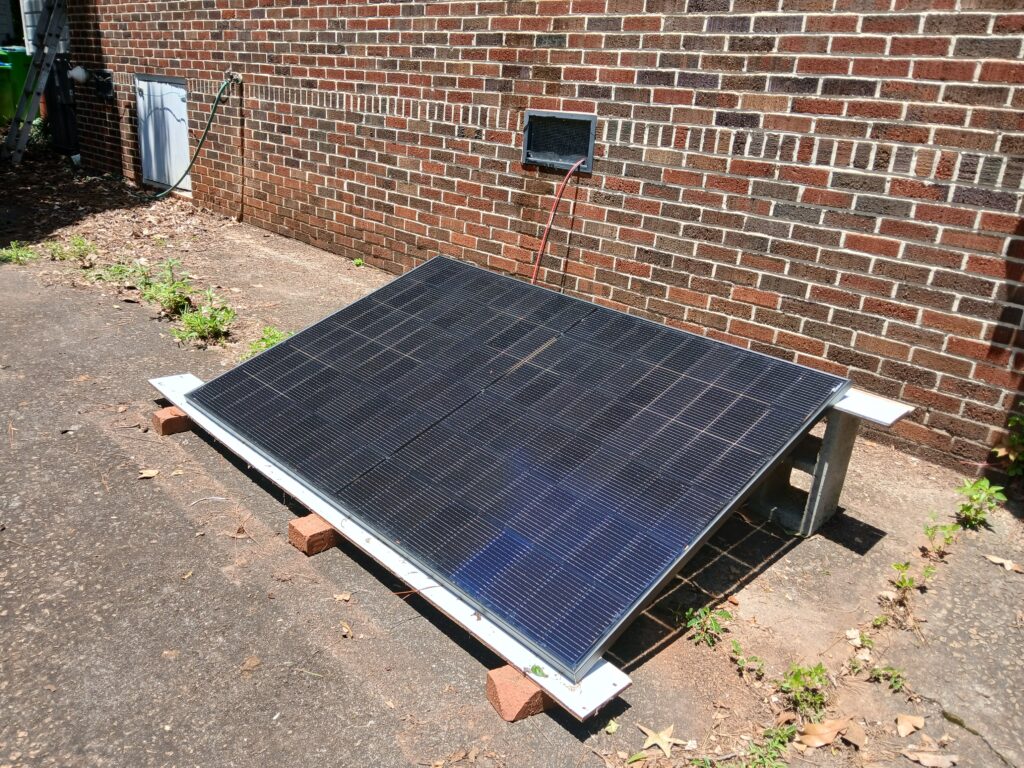
The generator weighs about 48 pounds mainly due to the weight of the LiFePO4 batteries (lithium iron phosphate), a safer lithium-ion chemistry that Aferiy says should last 10 years or 3500 charge cycles. It even comes with a 7 year warranty, which is great because it will take 7.5 years to pay for itself (very optimistically). By the time I got the generator, the solar panels and cable had already arrived so I was able to put my panels in my sunny driveway and start charging right away. It came with a 24% charge out of the box. I wanted to test each panel, so I just hooked up one panel at a time and, even though it was clear and sunny, I only got 150 watts from each, about half of what I was expecting, though it was already 3 PM and maybe I didn’t have the perfect angle. By 5 PM, the panels were in the shade and power had dropped off to about 10 watts so I unplugged the solar cable. I used the USB ports to charge my phone, iPad, and a portable power bank. Then I used the AC plugs to charge my laptop and run one of my backlit poster frames and a lamp, drawing about 40-80 watts, no sweat since it can provide 2400 watts, but it was down to 12% by the time I went to bed. At 1 AM I have smart plugs that turn off the frame and lamp automatically and I hoped the battery would last until 9 AM when the poster is supposed to come on. I set the battery to shut down when it got down to 5% to avoid a really deep discharge and it turned itself off around 3 AM with some beeps that I heard (acually I realize that was probably the 10% remaining warning). The next day I was wondering what time I would be able to start generating power. Sunrise is about 6:30 right now and I did have to get up early, but the panels were pretty shaded most of the morning. I thought maybe ambient light would work, but when I plugged the solar cable into the generator, it would just repeatedly click and the Aferiy would not come on. The manual says don’t leave solar plugged in all the time because if light is sporadic it will keep turning itself on and off. That’s not great if I have to remember to plug it in every day and unplug it at the end of the day. Around 10 AM I was able to plug it in and it started up, telling me it was getting 10-20 watts. I moved the panels a little to be in complete sun a few minutes earlier and by 11 AM it was getting 200 watts and eventually about 300 watts. Nothing higher than that though.
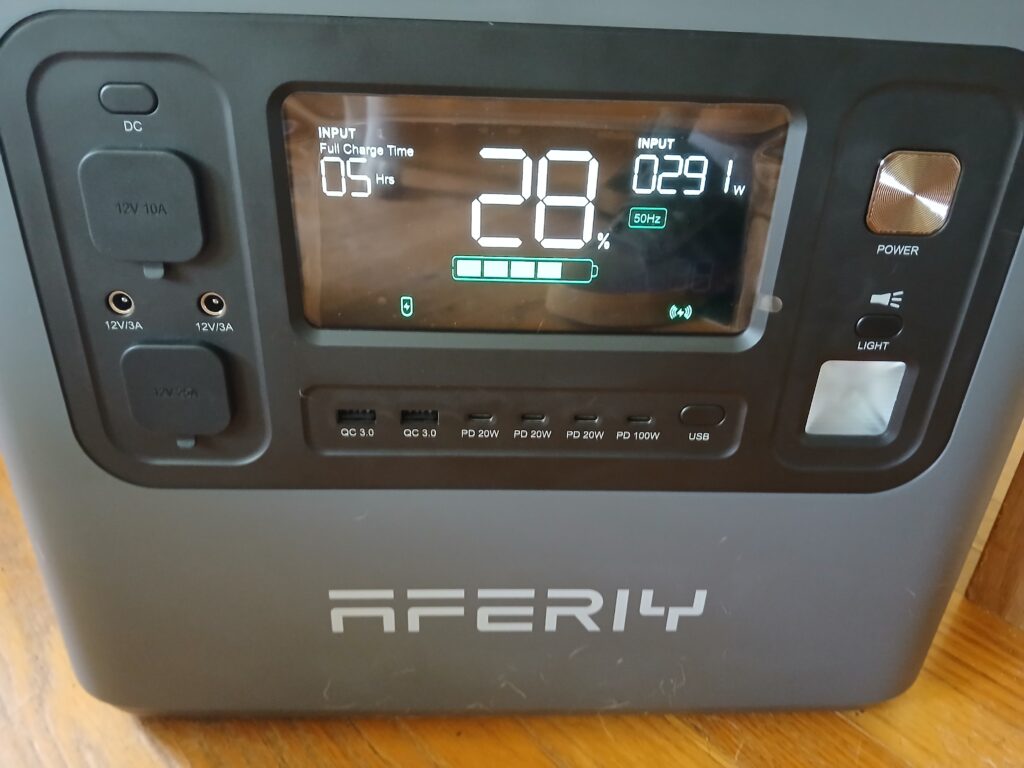
I did get it to 60% charged by time I unplugged it at 6 PM. I plugged in the lamp and poster again and did some charging and the charge was dropping fairly fast. I hoped it would last the night, but it finally shut itself down sometime before I got up. I think a big part of the problem is that when the generator is on, it is drawing maybe 30 watts just to keep itself and the inverter running (another generator, the Anker Solix S2000 draws only 6 watts). So if you are running it for a long time, you are going to lose a lot due to that overhead. From 5 PM when I unplug the solar panels to 10 AM when it starts collecting solar power the next day, at 30 watts, that’s 500 watt-hours, 25% of its storage capacity. So I don’t think leaving it powered on to keep the smart plugs running is a very good use of its power. It seems more geared towards using it for a shorter period of time.
It has wifi, so you can control it from your phone, but only if you are on the same wifi network. That makes some of the settings easier to get to, but it is pretty slow, taking a minute or two to connect and start getting readings, and then if you change a setting, that takes 10 seconds or so.
The next day I decided to try using it to keep the refrigerator running, so at 5:00 I carried it into the kitchen and then plugged the fridge into the generator. The fridge is one of my biggest consumers of electricty since it runs all the time, but is still only 1300 watt-hours per day. It uses 140 watts when the compressor is running, but the compressor doesn’t run most of the time. It uses 40 watts extra when you open the door and the light comes on, then drops back down when you close the door, so I feel like the light really does go off when you close the door. I plugged in my 1500 watt air fryer to heat something up for a few minutes and that was no problem, but the generator’s fan did come on (almost always off). Another possibility would be to put my window air conditioning unit (750 watts) in and power that for a while to help cool the house and maybe take some load off of the central AC, but that is more of an indirect savings than with the refrigerator where every watt-hour used while on the generator is a watt saved on my power bill (except the 30 watts of overhead that I lose). Using the window air conditioner might allow me to raise the main thermostat and just cool off the living room with the window unit during the afternoon. If I had bought a window heat pump instead of just an air conditioner, that unit would be a way of using up power in summer and winter (and would have been a much more efficient backup to my furnace than the little electric space heaters I wound up buying).
I noticed on the display that there was a box to the right of the percent charge (28% in the picture above) that says 50 Hz. In the US, electricity is supposed to be 60 Hz. Not in the manual, but somewhere I read that it automatically switches to the correct hertz, but I couldn’t change it in the app or via the machine itself. I looked up whether that was a problem running a 60 Hz refrigerator at 50 Hz and it can be a problem, though most things will still run. I wasn’t sure how it would know that my refrigerator needed 60 hz. At some point after I had run the air fryer and refrigerator, I noticed that it said it was outputting 400 watts, but nothing was running. I opened the fridge door and the light came on. I unplugged the fridge to put my Kill-a-Watt monitor in place and it stopped reading output of 400 watts. The Kill-a-Watt confirmed 50 Hz. The refrigerator’s compressor hadn’t kicked back on yet, so I was worried I had broken it. In the manual it did say that when you first start using the generator you should give it a full charge and discharge cycle to help it calibrate the percentage of battery power. However I never got it to 100% with solar power and I never plugged it in to the wall for charging. It finally occurred to me that I need to plug it in to the wall so it can sample the local electricity. When I did this, it switched automatically to 60 Hz. After a while the refrigerator continued to work normally, so I don’t know what was going on with the 400 watt output reading.
I am not sure why I am not getting more than 300 watts from my 600 watts of panels. Atlanta is kind of hazy and it was also partly cloudy, so the voltage would drop down periodically, maybe to 20 watts when a cloud would go by. The 300 watts was when there wasn’t a cloud. It could be some of the light is being filtered by the haze. The bad thing is we are close to the longest day of the year, so in terms of total solar power I can collect this is about as good as it gets. If I installed the panels on the roof, they would get as much as an hour more sunlight than in the driveway, but would still be affected by trees starting around 4:00.
The Werchtay 250605001 panels sold by Rayscape on Walmart’s website were pretty cheap with only one review that said they seemed good without any details. They are real panels, with aluminum frames, not the fold up portable kind. They are advertised as N type panels, which are supposed to be a little better and have 18 bus bars, if that helps. Reading some reviews of panels on Amazon, it is not uncommon for off brand panels to produce less power than they say, whereas Amazon reviews indicate a more reputable brand like the Callsun 200 watt panels actually produce 200 watts (or even a little more), but would also cost more (interestingly, those 200 watt panels at 51″x30″ are a little larger than my “300 watt” panels at 53″x26″). Buying two 300 watt panels that only produce a total of 300 watts for $260 isn’t as good a deal as buying two 200 watt panels that actually produce 400 watts for $330. I did look at the Callsun panels, but they produce 27 volts and 8.4 amps, so I would need to wire two of them in parallel so that I don’t exceed the 50V limit of the Aferiy. I don’t have much of a way of testing if the panels are really 300 watts each other than what the Aferiy generator says (edit: the Aferiy seems quite accurate), but I could try measuring the amps and voltage while everything is working to see what current is actually going into the generator, since maybe more is going to the generator than it is reading out. My understanding is that if they aren’t getting full sun, they will still provide close to full voltage, but the current will be lower than the max.
There could also be resistance in the cables. There shouldn’t be, I bought heavy duty #10 AWG wire and they are only 30 feet long. I even took the generator outside and hooked it up directly to the panels, but got about the same charge rate bypassing my cables. Looking at the cable that connects the solar cables to the XT90 port on the generator, those wires don’t look like #10 AWG wires (looking closely they have #14 printed on them, so definitely lighter duty). That adapter cable is what came with the generator, so I ordered a heavier duty version for $20 from Amazon and should get it next week (got it, seems to help a little). That isn’t going to double the wattage, but maybe I will see some increase. The leader cables attached to the panels also aren’t #10, but again, they are pretty short, so losses shouldn’t be much. I don’t think they can be replaced.
Another possibility is the generator could be very inefficient in converting the incoming voltage to something that it uses to charge its batteries. 50% would be pretty terrible since MPPT DC to DC voltage converters are supposed to be around 90% efficient. Could also be a combination of all of the above. Even though I am only getting 300 watts instead of 600, really the generator maxes out at 500, so I am at 60% of what I expected. I am also taking a hit by charging it down to 5% instead of 0, plus the overhead losses when it is providing AC power which add up the longer it is in use. I think the most likely culprit right now is the solar panels and I wonder if I should try to return them (in the end, I bought a different panel at Amazon and returned the Walmart ones).
One advantage to not being able to fill up the generator every day is that it takes away the pressure to use up all of its power every day since I can save it for the next day and still not be wasting any power.
The Aferiy manual said to fully charge, discharge, and recharge the generator to calibrate the battery monitor. I charged it up and ran two lights totaling 50 watts from 100%. It lasted 24.58 hours (at least the last hour it said 1 minute remaining, so I guess that is part of the calibration). So that’s 1,229 wh. If it really has 2,048 wh of storage, then 819 wh were wasted on overhead, or 33.3 watts. That means the efficiency at a low load like that is only 60%, though people get much higher rates at higher loads and Aferiy says use 85% to calculate runtimes.
I was going to test the current and voltage coming from the Werchtay panels, but I am pretty confident that the 150 watts per panel indicated on the Aferiy is correct and I will return them. One problem with measuring the current is there are some fairly high DC amps and my multimeter only goes to 10 amps. I bought a clamp meter that should be able to measure DC amps without actually touching any wires, so we will see what it says.
I went shopping for a replacement panel. Since I can only collect 500 watts max, ideally I would get a 500 watt panel, but they don’t really make those, which is why I got two 300 watt panels before realizing they don’t really make those either (I think they just relabeled 200 watt panels). So I was going to get 2 200-watt Callsun panels from Amazon (customers report getting more than 200 watts from them), but today I saw a 425-watt JJN panel that gets very good reviews, costs the same as the two lousy Walmart panels, and has fast shipping (2 days), so I will see what it can do. It weighs over 50 pounds since it is basically like my two panels put into one. It is bifacial which means it can actually collect additional solar energy from the bottom side of the panel if the bottom side is exposed to light. I don’t know that it will make a difference for me, but people who are able to mount these up in the air so the backside can see sunny ground instead of on a roof where it can only see its own shadow can get up to 20% more output.
I also ordered a DC switch from Amazon so that I can just turn the panels on and off instead of plugging and unplugging the XT90 cable into the Aferiy which is awkward. It is hard finding a good switch for higher wattage DC use, but this one is used as a cutoff for boat batteries and is good for up to 48V and 275A, so it should be plenty, especially since realistically I will only use the switch when the panels aren’t producing much electricity. I will have to cut the wire of my new XT90 cable to tie in the switch, which I kind of want to do anyway because even though that cable is supposed to be #10 AWG wire and it even says #10 on the side, it seems very flimsy. I do feel like it allows more current through than the original since the panels got up to 330W yesterday, though it was also a little cooler which can improve the performance of the panels.
I got the new panel late Thursday. It is really heavy at over 50 pounds but also really awkward to carry, almost my height and about 4 feet wide, like a 75″ TV. I could easily pack the smaller panels in my car, but I don’t know that I could fit the new panel at all. I put it out Friday morning and it started getting power right away even though it was overcast (not much power, like 40 watts). At some point during the day a break in the clouds let it get up to 430 watts for a few seconds, so I feel like the Aferiy is reading the input accurately, the new 425 watt panel is great, and I started a return with Walmart for the old panels.
Walmart said I didn’t need to repackage the panels and could drop them off at any store for a refund. I will do my best to repackage them anyway and hope maybe they get used someday instead of probably going to a landfill. When I took them in, they checked to make sure they were actually in the box and then stuck a FedEx shipping label on them to Ontario, California, so I guess I could have just had Walmart tell FedEx to pick it up at my house. Who knows what happens there.
Because the Aferiy wastes 30 watts when providing AC power, it is best to use up the power quickly. I hooked up the window air conditioner which is rated at 750 watts, but really it seems to use 620 watts on full blast. That’s enough to drain a full charge on the Aferiy in a little over 3 hours, although once it cools the room off, power consumption drops. I am not sure how much of that energy use will translate to a reduction in my power bill though. In Summer it seems like a great solution to use the sun to cool off the house while electricity demand and solar production is at a peak. I am not sure how I can efficiently use the power the rest of the year though. I think balcony solar will be a better solution when it becomes widely availble, since it just offsets your entire house’s power consumption. I could use the new panel in a balcony solar setup, but the panel was only half the cost of the generator.
Today is Amazon Prime Day and prices on the Aferiy generator and the JJN solar panel both dropped. I could have saved $134. That’s over a year of power savings. Ouch.
If the two 300 watt panels had really worked, that would have been a lot more optimal than where I ended up. Getting 500 watts, which is the most the generator can handle, and is probably enough to fill the generator in a day, isn’t easy without buying 3 200 watt panels (tripling the amps or voltage), or maybe 4 in order to get the voltage and amps to work out (doubling both amps and volts, but usually wasting a lot of power). I saw that the 425-watt panel was hitting 430 watts every now and then, but mostly was in the 340-380 watt range between clouds. That means I can’t fill the generator from empty in a day, but shouldn’t be a problem getting 1 or 1.5 kwh.
I have been charging up the Aferiy up to 60-80% with solar power during the day and then, starting at about 3 PM, running it down to 5% by running the air conditioner and charging anything I can for the 2-4 hours it takes to use up the power. Last night there was a storm and the power went out for about an hour, but I was already down to 5% charge, so I just used flashlights for lighting like usual. When the lights came back on I thought I could charge it up to 30% or so in case there was another outage, but didn’t want to fill it with grid power. Of course then the power went out again for another hour. My hope is always that it will be so sunny I will get up to 100% charged, but that hasn’t happened yet. So instead, maybe it would be better to charge it down to only 30% so I have a emergency reserve (which would have let me watch the World Cup game uninterrupted, though I would need to get power to the Tablo and router). Then during the day if the charge gets close to 100%, I could just start running the air conditioner early which uses power faster than the panel can supply it.
I have not been able to fully charge the generator in a day and, even though the new panel is rated for 425 watts, it spends the first hour of the day from 10 AM to 11 AM around 200 watts and then maybe 300 for an hour, and then generally around 380 up until 4 when the panel ends up in the shade. In the meantime there are clouds or maybe just haze that temporarily lower the power. I end up filling it about 60 or 70 percent per day. So I thought if I got another panel I would be able to more consistently deliver the 500 watt maximum that the generator can take and maybe be able to fill the 2000 watt-hour storage capacity it has during the 6 hours that I get sunlight. I ran some numbers for my power savings and how many years it will take to break even and they aren’t pretty. Because of the lower collection rate of the panels and the inefficiency of the generator to use that power, it would take 12 years to pay off the system instead of 7 or 8 that I originally estimated. However, even by spending another $300 for a second panel, the increased production might allow me to pay off the more expensive system a year earlier. It isn’t terrible. The panels last 25 years although their production drops to 80%, so again, having another panel will be helpful as production drops and I have to pair two similar panels, so it may be best to get a matching panel while they are still available. I will need to put the second panel in parallel to the first so I had to buy a set of Y cables to combine their outputs ($8). When the sun is at full brightness they will provide the generator with excess amps, but it should limit itself to accepting 500 watts, which will be 16 amps since the panels supply a voltage of about 32 volts. I am hopeful that I may be able to collect more than 2000 watt-hours in a day and therefore use up some of the excess power as it is being created.
I got the second 425-watt panel on Tuesday and hooked it up in place of my older panel since the splitter cable wasn’t here yet. That was a good chance to monitor what it could do and it quickly got a burst of up to 460 watts, so that is even better than the first panel. Yesterday evening I got the splitter cable and hooked up both cables in parallel. By 11 AM I was collecting the maximum that the Aferiy can handle at 500 watts. I measured the current and it was about 16 amps so the voltage is about 31V. Starting from a 24% charge, it was up to 100% by maybe 1:30 thanks to a generally very sunny day, so I started running the air conditioner so I could continue getting more power. Since the air conditioner uses 600-700 watts when the compressor is going and I can get 500 watts from the solar panels, it doesn’t drop the charge particularly fast. I am wasting a lot of potential power by having more panel watts than what I can collect, 300-400 watts wasted during the peak, but when things are off peak (below 250 watts), I can double what I was collecting before. It is great for summer to be able to use up any amount of power by running the air conditioner, but it may be a challenge for the rest of the year. A window heat pump which could provide heat in the winter might be a good way to use up the power I am collecting. I have a couple of electric space heaters, but they are maybe half as efficient as a heat pump would be. One heat pump I saw only works with an outdoor temperature down to 41 degrees.
I got my July power bill today and saw a surprising 30% drop in my power consumption compared to last year, dropping from 544 kWh to 380 for a savings of about $27. This is a bigger drop than the $10 of savings I hoped for.
Georgia Power lets you download your daily power usage for the last two years and includes the high and low temperatures each day, which is a nice way to try to see what impact temperatures may have had. The common way to do this is by calculating “Cooling Degree Days” which figures out how many degrees of cooling you needed each day. They seem to calculate this by taking the average temperature for the day (or the average of the high and low, if that’s all you have) and subtracting 65 degrees (I think 70 degrees is better) which is the outdoor temperature at which you might start to need air conditioning. If the number comes out negative, you make it zero because you probably didn’t need air conditioning that day (maybe getting into Heating Degree Days). So of course I had to do that.
There are some things working against the July comparison. First the time periods are different because this year’s bill covered June 30 to July 30 (30 days) whereas last year it was June 13 to July 15 (32 days). Also last year’s billing period was hotter than this year’s which, using my CDD calculations, comes to an average of 15.75 degrees per day this year and 17.30 last year. If I correct last year’s number to take into account service days and CDD, the comparable consumption would be 464 kWh last year, which means my consumption is down only 18% this year instead of 30% (a savings of $14 instead of $27). The difference in usage would still be 84 kWh, but the Aferiy only stores 2 kWh per day or 60 kWh if I utilized it at 100% every day (which I can’t do) for a month. However, I can get a little more power than what it can store by using its power as it is produced instead of storing it. There may be other things at work, too. My washer and dryer broke in July so that reduced some power usage for a week. But I also didn’t have the window air conditioner running the entire month and I didn’t have both 425 watt panels running the whole month either. I feel like I could have done a little better.
Still, it was a notable savings during a month when I typcially use a lot of power. I think by turning the thermostat up to 80 degrees for the whole house during the afternoon while using the window air conditioner to keep just the living room a comfortable 76 degrees I may be saving more kWh on my bill than what I am collecting and using (mostly for the window unit).
I plugged in the air conditioner through the Kill-a-Watt and on really sunny days, about once a week, I am sending just over 2 kWh to the AC, which means I am using more solar energy than I can store in the battery. And that is after taking out the inefficiency of the Aferiy and using a few hundred watt-hours to charge my phone, laptop, iPad, and sometimes run a poster frame for a few hours. On average the AC is getting about 1.5 kWh per day, which is all solar. The Aferiy does not have a way of tracking how much power it is receiving other than its percent full, but when I am getting solar and using it at the same time, that doesn’t work.
I got my August bill today. The Georgia Power billing website is down all week, but they told me the amount of my bill and that I used 26.47% *more* power than last year’s bill, plus I knew the billing period already, so I was able to figure my usage was 430 kWh over 33 days. I was able to backfigure my Community Solar take as well, which should be 148 kWh. Again this month, it is not an entirely direct comparison. Last year there were only 32 days instead of 33. But the big difference was that last August was unusually cool, needing on average only 7.6 degrees of cooling per day whereas this year required 12.4 degrees. If I make corrections for the days and the CDD, then last year’s usage would go from 340 kWh to an equivalent of 447 kWh, meaning I only saved 17 kWh all month. However I think I need a better formula to correct for CDD, and that cooling isn’t directly proportional to CDD and as it gets hotter, you need extra cooling. This is despite me not magnifying 6 kWh each day as my base load and using 70 degrees as the average daily temperature where I need cooling instead of 65 when calculating CDD. If instead I just compare days that have the same amount of CDD, it seems like I am generally saving about 2 kWh per day though there is some variation, I think often due to using the dryer.
I also ran the Kill a Watt all month on the window air conditioner and got 48 kWh actually going to the air conditioner during that time period (about 1.5 kWh per day, with a goal of getting 2 kWh per day of solar), so that is after all losses, plus I am charging my laptop, phone, and iPad every day from the Aferiy, but that was probably only 2 or 3 kWh for the whole month.
Meanwhile, as Fall approaches and the sun stays lower and the shadows get longer, I am taking a big hit on power production. I don’t hit maximum power until noon and by 3 PM the panels are in another shadow.
Could be better, could be worse. The next step is I need to get a permit from the city to attach the panels to my roof which should help some with the shadows. I went ahead and got the hardware, but it will take a couple of months to apply and get approval of the permit, assuming all goes well. Then I will need to actually do the installation, which I am feeling better about, with my main concerns being not to cause any leaks, tying into the roof rafters that I can’t see from outside, and getting the wiring into the house.